Book review: God Emperor of Dune

Book: God Emperor of Dune
How to start with this book... Well, first of all, beware the spoilers, as it is impossible to provide a review without speaking about the previous books and a bit of what happens in the current one.
So, on with it: At the end of the previous book, Leto Atreides fused with a sandworm. Thousands of years later (around 3500), he is a huge speaking worm, keeping only tiny arms and the face from his human past. He seems to have even more acute senses, be almost prescient of any future event, maybe even mind-reading, and apparently impervious to any damage (like laser weapons). He also seems to have become a despotic emperor, a strict ruler that maintains peace over the universe by fear as much as by being strategic.
Arrakis also has been terraformed, with the sandworms and thus the spice nowhere to be seen. It is now almost full of vegetation, and water is abundant, but the people seem not to be overly happy, although nobody would dare to mention it. "He who controls the spice controls the universe" (they say in the 1984's David Lynch movie adaptation), and indeed by keeping the remains hidden and deciding who gets how much, he now controls everyone: The Ixians, the Spacing Guild, the Bene Gesserit, and other houses (who have also become smaller and weak). Leto also has a special army of women soldiers, fanatically loyal to him. He also keeps asking for Duncan Idaho's new gholas (clones), and seems to be easily angered and dangerous when it happens.
But a descentant from the Atreides, Siona, seems not to care at all, breaking as many rules as possible to try to find a way to end the reign of this god emperor.
As you can imagine from the previous paragraphs, this book is way more into science-fiction than previous Dune titles. And similarly happens with it being "Dune"... Same as the terraformed Arrakis, at times it feels like Dune, but mostly it is vastly different from the past (books). The emperor is so powerful and capable, everything is so transformed and under control, that everything is... different, lesser than it was before. From the Fremen, to the Bene Gesserit, they all look weak and a shadow of the past. And this is my main issue, that it is a curious science ficton reading, but not a good Dune book.
While I was intrigued about how all this crazy setting would end, I don't think that it is a good Dune book. But it does make for a very different sci-fi one!
Book review: Children of Dune

Book: Children of Dune
Note: I can't write about this title without spoilers from the previous ones, so jump directly to the last paragraph if you wish to avoid them.
The third book of the Dune series, Children of Dune happens 9 years after Dune: Messiah. Blind and no longer with premonition powers, Paul went to the desert to die. His sister Alia is now in command, but something is not going well, both inside her and in the imperium. Plots and conspirators are everywhere. Dune is now advanced in the terraforming efforts, with some areas quite green, rains, and Fremen are starting to become used to water no longer being a scarce resource.
Paul and Chani twins, Leto II and Ghanima are 9-year-olds with an incredible intelligence, fully aware that something is amiss with Alia, and that they must do something to regarding their aunt, the Atreides empire, and maybe even Arrakis.
This book switches the main protagonist obviously from Paul to his family. We will learn about Alia's "issues", but the real main characters are the twins. This book also departs a lot from a "mild" sci-fi setting (worms, ghoulas and prescient powers aside), to fully embrace the fiction part. Without spoiling much, the premonition and inner voices powers that both Alia and Paul's children have go way further than the powers that Paul had, and there will be other plot twists and events that will surprise you.
The first half of the book is relatively calm, pretty much focused on politics, conspiracies and developing the characters. But, once you pass the first, half it jumps into a series of events that made me spend some long night sessions reading on and on, wanting to know what would happen next. Definitely more science-fiction than the previous titles, and, in my opinion, highly recommended.
Comic Book review: Dune: The Graphic Novel books 1 & 2
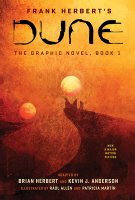
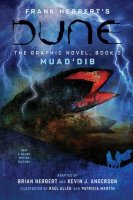
Books: Dune: The Graphic Novel Book 1 & Dune: The Graphic Novel Book 2
Continuing my desire for more Dune content, after the first two books and watching the movies (and now going to watch 2024's Dune Part Two), I recently discovered that there were some graphic novels based on the books; Two already published, and a third one coming mid 2024. What I did not know is that each graphic novel covers one third of the book... so be aware of that detail.
The writing is mostly directly taken from the book, so many dialogues are 1:1 matches. It sticks very close to the original content, so excepting a tiny change here and there, most of it has been ported entirely. Brian Herbert is listed as one of the authors, so that's probably why it is so accurate.
Where you will see some differences is in the visual style. After having two movies, many videogames and concept art/drawings, I at least have my image formed of certain aspects, like the Ornithopters, the Harvesters, even how the Harkonnen look (pale, bigger than normal humans, with dark clothing...). The style adopted by the illustrators is not bad, but reminds me more of the 1984 David Lynch's film than the other pre-existing materials, and sometimes feels not too elaborated; for example the Harkonnens look the same as the Atreides, and even the Baron is not very imposing. Don't get me wrong, it is not bad, just that the visual style didn't click with me.
Interesting additional material, but I'd go read the book instead. In any case, I will grab the third and last graphic novel book when comes out, and see how the more action-packed part is depicted.
Book review: Dune Messiah
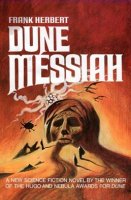
Book: Frank Herbert's Dune Messiah
The first Dune book got me even more interested in Frank Herbert's universe, so I had to keep reading. I recently finished the second physical title (according to the "internal" numeration, it would be the fourth book), so here comes a small review.
Again, the first half of the book was very slow-paced. There are many moving pieces, at times unclear exactly to what purpose, and very detailed conversations and explanations of the state of things (12 years have passed since the first book's events). But then, everything begins to connect; events, plots, and characters advance.
It is a different book, not a mere continuation. The main character, Paul, feels tormented by his foresight; his close friends doubt him, and people question his decisions or directly conspire against him. And some new characters are disturbing, specially the "gholas", clones of deceased humans with metallic eyes and reprogrammed memory (but recalling most of their past).
You won't find here the same positive and encouraging story of the rising of a hero against oppressors. But it gets fascinating, with a thrilling "last act" finishing with an ending that makes you want more.
Book review: Dune
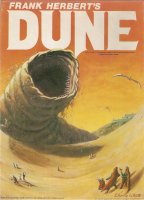
Book: Frank Herbert's Dune
Dune is a science fiction story set in a distant future where noble houses rule different planets, alongside an Emperor and his elite Sardaukar troops, and a powerful trading guild that controls space travel. The plot follows a young Paul Atreides and his family as they take charge of Arrakis, a desert planet that is the only source of a valuable substance called melange or 'spice'. The spice extends life and enhances mental abilities, and it is crucial for space travel. The Atreides arrive to Arrakis to control it by the Emperor's orders, but things won't be as easy. The story explores complex themes of politics, religion, ecology, technology, and human emotions as different factions in the empire clash over control of the planet and its invaluable spice.
Yet another timeless classic that I had pending and decided to go for. In this case, even more so because Dune 2 is one of my all time favourite videogames, so I felt I had a pending debt to settle. And I like both the old and new movies, so needed to see the source of it all.
I've enjoyed the book so much so as to plan to keep reading at least one more book (potentially until God Emperor of Dune, included). I knew it was good but didn't expected to hook me in so much. At times it felt like The Lord of The Rings, providing long and detailed descriptions of seemingly trivial characters, scenarios and details. Then, the "characters thinking" technique (you read what they think at times, not only what they say) is different and interesting, providing with additional details and more insight on how and why different characters act the way they do.
It is also different from what I expected: The scarce technology (the Ornithopters, meelee shields, spice harvesters, and some "laser weapons", but not much more) was a surprise to me; In the strategy videogame there are tons of vehicles, troops with different long range weapons, but in the book fuel is scarce and vehicles at times deteriorated, combats are mostly melee, and in general everything feels not as futuristic as you'd imagine. Reading at Wikipedia I saw that the author wanted to replicate a feudalism-like setting, much more focused on the human and politics side of things, and it is clearly there.
The only thing that I can complain about is that the pacing begins very slow, but speeds up and actually jumps ahead years by the end (few, but still), giving the sensation that you missed something in the middle. It is a long book, and yet I expected more things to happen in the kind of "final story arc", instead being a bit short. But maybe was just me wanting to read more about the intriguing Fremen, the Shai-hulud, and Arrakis itself.
A sci-fi must read.
- ← Newer Articles Page 1 / 1 Older Articles →